
The Coordination Problem
Why corruption persists and what we can do about it.

John Omondi works for his county government as Chief Financial Officer. As the person in charge of finances, he works closely with the procurement department and processes and authorizes payments for whichever company or individual that the county contracts. If asked, Omondi says he’s not corrupt even though he has processed several illegal payments before. Some for the governor and a few for himself. Omondi believes he'll lose his job if he does not make illegal payments to the governor. Furthermore, if he doesn't do it, somebody else will do it.
Alfred Njuguna is a police officer stationed somewhere in Nairobi. His day job is to patrol the city and ensure there's order. However, he also visits all Wines and Spirits within his jurisdiction and demands bribes. Owners are angry and tired of Njuguna's corrupt behavior, especially now when taxes are high and incomes are low. Njuguna believes he's not corrupt and only tries to meet the OCS's daily quota. Of course, any amount that exceeds the OCS's quota is his. Furthermore, he also fears that if he doesn't do what the OCS wants, he will be transferred elsewhere, far from his family. He'll be replaced by somebody else who will do it.
Wilberforce Wafula was out drinking last night. After two to three bottles, he overestimated his sobriety and decided to drive home. Halfway, he hit a pedestrian, and the car drove into a ditch. The pedestrian sustained serious injuries. Wafula was arrested. While in transit to the police station, he started talking, telling the cops how sorry he was. He was remorseful and pleaded that he be released. Unsure of whether it was the right thing to say, he told the cops, “hii ni story tunaeza ongea. Si lazima twende mbele” (This is something we can talk about; no need to proceed to the police station). The cops stared at each other and then pulled over.
I've highlighted these three cases because they accurately tell Kenya's corruption story. More cases and stories exist, but these three will suffice for now.
Corruption is a thorny issue that is hard to solve, yet everyone believes they know the solution. Really, how hard can it be? Ask anyone, and the solution is as easy as don't be corrupt, be moral, and don't give or demand bribes. Cops are told not to demand bribes, while the public is told not to pay bribes. Easy peasy. However, something already tells us this is not enough, and no matter what we think is the solution, corruption persists.
According to Scott Alexander in his “Meditations on Moloch," the problem I've laid out is the same one that plagues many aspects of governance, the economy, and even politics. Many people complain about capitalism, for example. They allude to a "system" that has somehow conspired to make them suffer. However, it remains unclear who is part of this system and how it’s perpetuated, even though there's no one in particular running it. Scott writes:
Imagine a capitalist in a cutthroat industry. He employs workers in a sweatshop to sew garments, which he sells at minimal profit. Maybe he would like to pay his workers more or give them nicer working conditions. But he can't because that would raise the price of his products, and he would be outcompeted by his cheaper rivals and go bankrupt. Maybe many of his rivals are nice people who would like to pay their workers more, but unless they have some kind of ironclad guarantee that none of them are going to defect by undercutting their prices, they can't do it.
The problem this capitalist is facing is similar to the one Omondi, Njuguna, and Wafula are facing. Even though the three of them know corruption is wrong and that everyone would be better off without corruption, they all can’t help it because the decision to be or not to be corrupt doesn’t solely rest on them and is somehow tied to the behavior of other people within the same system. For Omondi, his corruption depends on the governor’s behavior. For Njuguna, it’s the OCS; for Wafula, it’s the cops and their incentives. This situation makes it very difficult for anyone to solve corruption in the system even though everyone is adversely affected by it.
Like the capitalist who goes bankrupt in case he pays his workers above minimum wage, Omondi would lose his job if he were to follow his moral conscience and avoid corruption; Njuguna would be transferred to a different region far from his family, and Wafula would end up in the police cells where he would be treated badly, pay an even larger bribe to the OCS, or end up in prison. In this competitive system, integrity isn’t worth much.
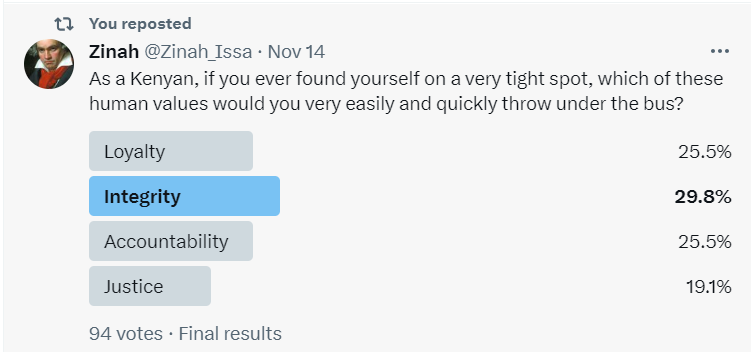
The answer to why corruption and, to a larger extent, dysfunctional governance persists is that individuals in each system behave the way they expect others in the same system to behave. Because no one in the system has enough information to know how other people will behave, they do what they expect others in a similar situation to do. Furthermore, each individual calculates how much a particular behavior would cost them vis a vis the expected benefits. Being morally upright sounds good; every virtuous person aspires to that. However, very few people would trade their jobs, freedoms, and livelihoods for it.
Scott sums up the problem nicely:
A basic principle unites all of the multipolar traps above. In some competition optimizing for X, the opportunity arises to throw some other value under the bus for improved X. Those who take it prosper. Those who don’t take it die out. Eventually, everyone’s relative status is about the same as before, but everyone’s absolute status is worse than before.
In Kenya, when it comes a time for people to throw integrity under the bus, many people elect to do it and prosper while at it. At the same time, those who do not die out are spat out by the system and go back to their family and friends who ask them, "While others were eating, why didn't you eat?" It is lost to everyone in this system that corruption leaves everyone worse than before and that any momentary gains accrued will get wiped off in the long run through corruption. Governors must always bribe party leaders, CSs, and the courts. OCSs consistently need to bribe their superiors, and the president himself has to bribe voters. Everybody is worse off at the end of the day.
As Scott suggests, the problem we are all facing here is one of coordination, which I also believe would be the solution if reversed. The people in these systems have no way of communicating, and everyone has to second-guess the other person's behavior. Even though we can all agree corruption is illegal and immoral, there's no way of coordinating people's actions. When an individual believes another person in the system will not cooperate with agreed-upon standards, they are also not incentivized to adhere to them. Simply put, people will stop being corrupt if guaranteed that no one else in the system will be corrupt.
I'll give two examples that show the importance of coordination in various aspects of life. The first one is M-Pesa. Even though unrelated to corruption, M-Pesa allows everyone in the country to transact without worrying about inconveniences from transacting cash. With cash, you must consistently worry about change, theft, and losing money. However, M-Pesa ensures you can always send the right amount of money to the right person. It has a robust system of authenticating all transactions. In case of a mistake, it allows the individual to reverse the money. Initially, people would abuse the reverse system, but the problem was easily solved by calling both individuals to confirm the reversal and restricting the number of reversals that can be made. Essentially, M-Pesa has ensured that every transaction made is trustworthy and that every M-Pesa user can anticipate the other person's behavior at the other end.
Robberies have reduced since all thieves already know that many people don't carry cash around. Similarly, most businesses don't hold large amounts of cash as before since most goods and services are paid for using till numbers. Unless a thief wants to rob your phone or clothes, there's no good reason to rob. Others might be bold enough to demand you send them money or withdraw it, but this is more risky to them because it leaves a trail that detectives can clutch on. Essentially, we can say that M-Pesa is a coordinating platform that introduces a line of communication that everyone can trust. In the process, the ills that might have occurred due to a lack of coordination are effectively suppressed.

The second example is the government's e-Citizen platform. This one is pretty straightforward because it coordinates communication between the Kenyan government and its people. Instead of having multiple communication channels like before, all services that a person might want from the government are now centralized in one automated platform. As you'd expect, this reduces the amount of interactions that Kenyans have with government bureaucrats. In the process, corruption is reduced. Similarly, government officials, for whom it was their job to collect payments for the various services offered on the e-Citizen platform, don't have that mandate right now, meaning their bosses cannot fire them for failing to collect bribes or meeting certain quotas.
The government also increased coordination by introducing a single paybill number for all government services. This means the line of communication is clear to everyone in the system. There’s no more channeling funds to obscure bank accounts. Unless the bribes can be paid through the paybill number, no one asks, and no one pays. Interestingly, if things improve with e-Citizen, people will soon be able to track the progress of all their activities and services on the platform, meaning no more bribing to skip the line.
These two coordinating platforms work well, but they are insufficient. Reducing corruption will require more than just having these two platforms. Many more might be needed, and many more strategies need to be deployed. However, we will get more of these if we start thinking about coordination. The question to ask is how can we reduce ambiguity in the system. How can we improve communication between different entities? How do we reduce information asymmetry in the system?
I know many people hate the International Monetary Fund, but I am happy we've come to the point where we're served cold SAPs. Look at the IMF as a God looking down upon us. We inside the system know our problems but cannot solve them because we are in a competitive game with our neighbors and colleagues. Instead of cooperating to solve the problems, we defect because we assume they will also defect given the chance. However, because the IMF is not part of this circus, it forces us to implement certain coordinated mechanisms to solve our problems, albeit painfully. For example, the IMF demands more taxes. In the process, the government forces everyone to use e-Citizen and a single-pay bill number to reduce the money wasted through corruption. It also demands that all businesses have an ETR machine and that those businesses transact only with businesses that offer receipts, meaning they, too, should have ETR machines. The government is streamlining coordination, eliminating ambiguities, and enhancing cooperation to ensure everyone pays taxes. In the process, it solves the corruption problem while improving revenue collection.
A friend who works as an ambulance driver once told me that the amount of fuel government ambulances consume nowadays has a weekly cap and is only renewed at the beginning of every week. Initially, there was no cap, and many hospital bosses would fuel their cars and bill the ambulance. However, that corruption loophole was closed by capping it at Ksh 30,000 worth of fuel per week per ambulance. This reminds me of Schelling fences, which is yet another solution that can help reduce corruption while increasing the amount of coordination in the system.
Since there's a rule that says an ambulance can only use Ksh 30,000 worth of fuel or remain grounded for the rest of the week, many ambulance drivers don't consume more than Ksh 30,000 worth of fuel. This rule creates a fence around a behavior and restricts it from spreading beyond the fence. Many social problems can be reduced by creating fences around them. An example of a Schelling fence you might be more familiar with is the debt ceiling.
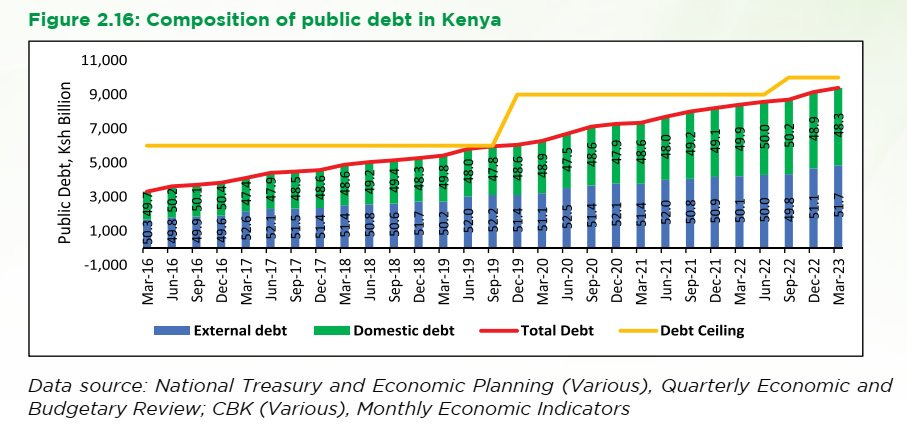
The debt ceiling works like the Ksh. 30,000 fuel cap, or the alarm you've set for the morning. The alarm tells you you're not supposed to sleep beyond a certain point because there will be nasty repercussions. A BMI of 25 is a Schelling fence for your weight, beyond which you are at risk of cardiovascular diseases. The 80kph is a Schelling fence for how fast you can drive on Kenyan roads. We have too many of these fences, and how they work is pretty intuitive to everyone. However, as we see with the debt ceiling or when you ignore the alarm even once, messing around with the fence creates a precedent for future misbehavior. This phenomenon is called hyperbolic discounting, and it's the inclination to pursue immediate rewards at the expense of the future, even though current rewards are very small. From the chart above, we see that Kenya raised the debt ceiling once, which created a precedent for raising debt ceilings every time we hit them. The rewards of raising the debt ceiling were lower than the price we must pay for the debt binge.
I don't know for how long the IMF will be around to hit us with SAPs. However, as long as they continue demanding efficiency and more revenue collection, we will have to create more effective fences, introduce new laws, and close many loopholes. It will be painful in the short term, but long-term prospects will likely be good. This does not mean I support all the new taxes introduced or the strategies that KRA is pursuing. I am only marveling at the ingenuity that we now have to deploy to solve our debt problems. Otherwise, the ingenuity we currently use for revenue collection or closing tax loopholes would have been used to make corruption worse.
Meanwhile, think of systems, technologies, and laws that would increase coordination and reduce information asymmetry. Another line of thinking is ensuring our effective systems are ironclad Schelling fences that cannot be changed on a whim. A system like QISJ is a good platform that allows new car buyers to verify the mileage of imported Japanese cars. A similar system could probably tell used car buyers the history of the car they intend to buy, whether it has been in any accidents, and of what severity. (This is technically what the "search" for land is). Maybe this solves the classic Akerlof problem in “The Market for Lemons.” Traffic corruption can also be reduced by replacing cops with cameras and automating fines. An Eskrow would reduce online scams while taming rogue businesses. Finally, I don't know why the EACC or even the DCI does not reward people who report corruption or other crimes. It would be a good incentive if EACC gave 10% of the proceeds of a successful asset recovery or conviction to the individual who reports the corruption. This would make integrity less costly to the virtuous.